With the majority of office workers now working from home as the UK remains in lockdown, office refurbishment specialists IRS (Installation and Refurbishment Solutions) say the time to re-evaluate whether their office is fit for purpose is now.
With the commercial property sector forecast to pick up in the latter part of the year, businesses may relocate to cities and regional centres featuring good connectivity, amenities, lower rent and house prices compared to central London.
And many businesses have concluded having their staff together in an office is essential to productivity, creativity and well being – but employers are now questioning whether their office is suitable, with its existing style, layout, number of desks and meeting rooms.
Paul Hazeldene from IRS, said: “We have seen the change in offices dramatically alter from around 2013. Very large companies and corporations employed people (and still do) from all over the UK and abroad who attend the regional or head office once a week or even once a month, and they began to recognise the huge problems this started to cause by unavailable desk space.”
These companies thought about relocating but usually they were already in an ideal location and they could not end their long lease. Their offices became unfit for purpose as they already had pre-allocated rows of desks and pre-booked meeting rooms – so how did the additional staff fit in?
Mr Hazeldene explains: “All existing desks, meeting rooms and offices (apart from heads of departments) were removed. In their place ten-seater high ‘Wagamama-style’ tables were installed, which instantly allowed additional staff to use the office and allowed everyone to hot desk at any table and just connect their laptop.
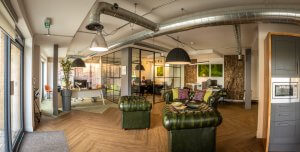
“Staff who attended the office five days a week had small locker space for their personal items and glass partitioned meeting rooms were installed to help create an open environment together with many break out areas invariably close to new tea points, containing sofas, armchairs, dining tables and coffee tables to enable the areas to be used for small meetings, quiet areas and opened-up for large meetings and event space, ideal for entertaining clients.
“We at IRS are now constantly refurbishing offices with the above style on various scales as more and more owners are recognising that their staff can combine working from home and attending the office. The office is retained but is becoming higher quality with larger break out areas, hot desks and glass partitioned meeting rooms closer aligned to airport lounges. These refurbished offices perform a hub role for employee interaction and client facing.”
Working from home may give employees a better work life balance and flexibility, but Mr Hazeldene says there are still things to consider.
“Not all individuals have space to work from home. They may be very cramped and have to share their property and this combined with a lack of garden space can lead to anxiety and can create difficulty in separating work life balance.
“All of this can lead to negative productivity. Also, remote managing is a skill set in itself, if it is carried out incorrectly micro and macro management can easily become confused.”
Mr Hazeldene concludes businesses should have a discussion with their landlord if they are looking to change their office layout.
“It is accepted for some companies a more traditional office is the best suited. However, if you have a business then it is worth having a discussion with your landlord to inform them that you would like some form of incentive, maybe in the way of an additional rent free period to enable you to modernise your office to encourage you to stay.”